

Creative Co-Pilot
A first look at using AI (Artificial Intelligence) to help improve how I make and promote my art.
Most creative types are now familiar with both the benefits and threats posed by AI (Artificial Intelligence). According to AI itself (OpenAI's ChatGPT), the reasons why artists feel threatened include:
1. Job Displacement and Devaluation
AI can quickly generate high-quality art, making it appealing to businesses seeking cost-effective solutions, potentially replacing human artists. The ease of producing AI art might also lead to a perceived decline in the value of human-made art.
2. Ethical Issues
Many AI models are trained on artists’ work without their consent, raising concerns about intellectual property theft. AI can also mimic an artist’s unique style, leading to debates over whether this constitutes fair use or unethical copying.
3. Loss of Creative Identity
An artist’s distinctive style can be replicated, diluting their creative brand. And, AI-generated art often follows trends, potentially overshadowing unique, innovative human expressions.
4. Economic Inequality
Larger organizations can leverage AI more effectively than individual artists, creating an uneven playing field. In addition, new artists may struggle to compete against the speed and efficiency of AI tools.
5. Cultural and Philosophical Concerns
Many value art for its emotional depth and human touch, which AI lacks, and over-reliance on AI might diminish society’s appreciation for the skill and effort behind traditional art.
6. Rapid Change
The fast pace of AI development often outstrips ethical and legal frameworks, leaving artists feeling vulnerable.
ChatGPT concludes it's response with this: "While some view AI as a threat, others see it as a tool to expand creative possibilities. Balancing AI innovation with respect for artists’ rights and creativity is essential for a harmonious future in the arts."
It's that part in bold above that stood out most to me and a big reason why I wanted to undertake a more intensive look at this technology, besides the fact that the techie part of me recognizes the huge impact AI is having and will increasingly have on our society as a whole.
"While some view AI as a threat, others see it as a tool to expand creative possibilities."

At first, my inclination was to think if AI could be effectively trained on my visual aesthetic, it could make make me better by providing insights we I could not uncover on our own, or could take me many times longer to do so. After purchasing a Pro subscription to Anthropic's Claude tool I realized the best way to start was by making it a thought partner, versus just having it try to make art for me. The core guidance for this was a quote by artist Agnes Martin that I feature in the introduction to my Painting & Drawing gallery: "Painting is not making paintings, it is a development of awareness."
From this perspective, the creative journey isn't about skill acquisition, it's about perceptual refinement and progressive self-recognition. Given this, the primary role of AI would be as an awareness amplifier, not a creative decision-maker. Help uncover patterns, articulate tensions, and track evolution, but the work and the "aha" moments are mine. Establishing that, an initial breakthrough with my "analog" painting and drawing work took place when I uploaded the images below.

Through my own initial analysis, I saw there were aspects of the sketches I liked that were missing in the paintings. The main intent of the sketches was to work out compositional themes, but they also help promote a looser, more intuitive style due to the greater immediacy of execution and lack of concern for a polished look. I felt the paintings needed to go in a more raw, openly expressive direction.
Claude help reinforce this and provide a way forward. It observed that my sketches had a "searching" quality (multiple overlapping lines, vibrating forms, ambiguity), whereas my paintings were beautiful but "arrived" - resolved, tidied, contemplative rather than searching. The key reframing it offered was don't just loosen up the paintings. Instead, use sketches to generate specific compositional tensions, then refuse to resolve them in the painting. A sketch thus becomes a constraint, not preparation.
Armed with a fresh perspective, I engaged in making some studies that would help refine this new approach before applying it to larger "official" works. I submitted the first three of these, shown below, to Claude for review.
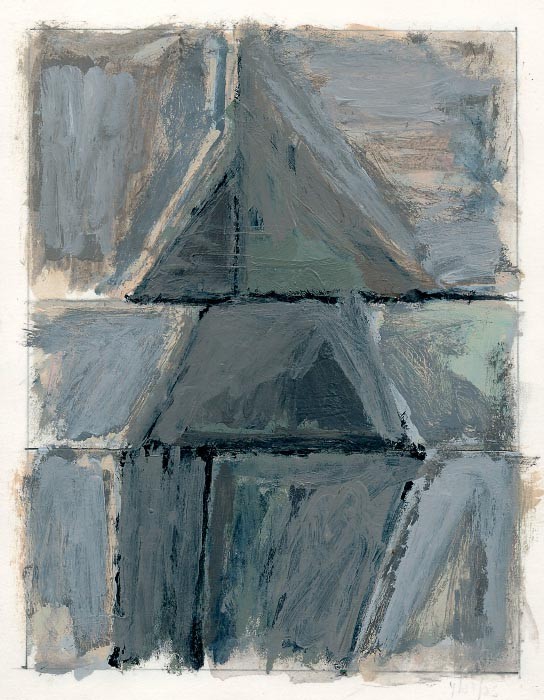
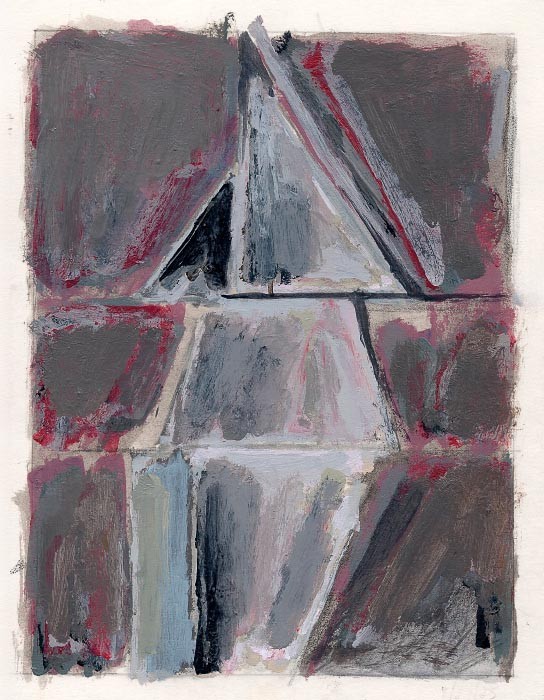
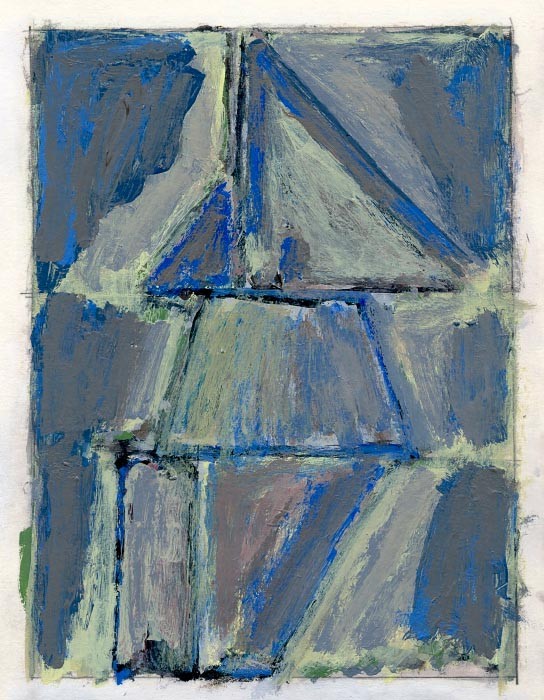
Claude's key observations were:
Obscuring edges creates interest — clarity isn’t the goal, vibration is. Rough edges keep the eye moving; clean edges let it settle.
Contrast is energy — too uniform = too passive. Need warm vs. cool, thick vs. thin, active vs. quiet zones.
The restraint muscle — recognizing when adding more would be too much.
Work teaches work — learning from other pieces and applying that vocabulary across the series.
A governing framework moving forward thus includes:
Working faster (outrunning editorial judgment)
Trusting initial gestures
Allowing rough edges to stay
Building layers without resolving contradictions
Modulating color and space intuitively as you go
Ultimately, success becomes about creating enough contrast (color, scale, texture) and variation to sustain interest while maintaining a searching quality. Create works dense with history but don't tidy away contradictions. Claude also recognized the power of creating variations on a theme, as the studies above show. They share the same underlying structure but feel completely different through color and brushwork variations. This approach speeds learning, creates cohesion, and becomes a constraint that frees versus one that limits.
Additional studies that further explore this more intuitive style and the concept of thematic variants have been posted to my paintings gallery, along with even smaller postcard studies. The latter further prove that working smaller means working faster, thus providing less opportunity to overthink.
As work in the studio progresses, I plan to post additional updates and insights here. Next steps for using AI include a review of my digital mashups, and help with the business aspects of marketing and selling my art. I also hope to offer additional perspectives on both the benefits and threats posed by this revolutionary technology.
Tagged
You might also like
-
It all STAX Up
- Written by bsullan
- Published on
-
Deja View
- Written by Brian Sullan
- Published on

